Another Classic book recommended by Christian Classics Ethereal Library is Tertullian’s book called ‘On Prayer’. This follows on from Origen’s book on prayer for a series of classic prayer books.
As with Origen, Tertullian was an early Church leader (155 - 222). Tertullian’s life was full of claims of heresy within the Church and counter claims of heresy in life. He is perhaps best known as being the author that first used the term Trinity to explain the Godhead.
Tertullian believed that prayer replaces temple sacrifices. He argued that individual petitions should be added to the Lord’s prayer - not that Jesus intended us to continually recite it word for word. Tertulian’s model for prayer also invariable focused on spoken prayer, and prayer together. This is linked to his view that prayer was basically worship.
Here is an extract from the beginning of the book”
The Spirit of God, and the Word of God, and the Reason of God—Word of Reason, and Reason and Spirit of Word—Jesus Christ our Lord, namely, who is both the one and the other, -has determined for us, the disciples of the New Testament, a new form of prayer; for in this particular also it was needful that new wine should be laid up in new skins, and a new breadth be sewn to a new garment. Besides, whatever had been in bygone days, has either been quite changed, as circumcision; or else supplemented, as the rest of the Law; or else fulfilled, as Prophecy; or else perfected, as faith itself. For the new grace of God has renewed all things from carnal unto spiritual, by superinducing the Gospel, the obliterator of the whole ancient bygone system; in which our Lord Jesus Christ has been approved as the Spirit of God, and the Word of God, and the Reason of God: the Spirit, by which He was mighty; the Word, by which He taught; the Reason, by which He came. So the prayer composed by Christ has been composed of three parts. In speech, by which prayer is enunciated, in spirit, by which alone it prevails, even John had taught his disciples to pray, but all John’s doings were laid as groundwork for Christ, until, when “He had increased”—just as the same John used to fore-announce “that it was needful” that “He should increase and himself decrease— the whole work of the forerunner passed over, together with his spirit itself, unto the Lord. Therefore, after what form of words John taught to pray is not extant, because earthly things have given place to heavenly. “He who is from the earth,” says John, “speaketh earthly things; and He who is here from the heavens speaketh those things which He hath seen.

The latest Classic book recommended by Christian Classics Ethereal Library is Origen on Prayer.
Origen was an early church father (185-254), and s you may suspect this book is mostly about prayer! In it he highlights four types of prayer from Timothy 1:
- requests
- prayer
- intercession
- thanksgiving
Origen led an amazing life culminating in his death after being tortured during persecution. He was a prolific writer, and wrote commentaries on all books in the bible. Not only that but he even wrote a corrected version of the Septuagint bible.
Here is an extract from Origen on Prayer:
Again I believe the words of the prayer of the saints to be full of power above all when praying ‘with the spirit,’ they pray ‘also with the understanding,’ which is like a light rising from the suppliant’s mind and proceeding from his lips to gradually weaken by the power of God the mental venom injected by the adverse powers into the intellect of such as neglect prayer and fail to keep that saying of Paul’s in accordance with the exhortations of Jesus, ‘Pray without ceasing.’ … For the saying ‘pray without ceasing’ can only be accepted by us as a possibility if we may speak of the whole life of a saint as one great continuous prayer.

The latest Classic book recommended by Christian Classics Ethereal Library is Catechetical Lectures of Cyril of Jerusalem (c.313–386).
Christian Classics Ethereal Library linked their reccommendation to a review from Lester Ruth from the Asbury Theological Seminary at the Calvin Institute of Christian Worship website, an extract of which is below:
Can a theologian be a good pastor or evangelist? Can an effective, church-growing evangelist be theological? Can a caring pastor preach doctrine in a relevant way? Is it possible for one person to be a dynamic evangelist, pastor, and theologian all at once? Many today would answer “no.”
Lester Ruth
This month’s free audiobook from Christian Audio is The Man Who Was Thursday by G. K. Chesterton. It will only be available in March so don’t hang around. If you are too late than you can get free text/pdf copies of the individual copies of the confessions as shown in the links at the bottom of this article.
The Man Who Was Thursday is a novel about two poets, Gabriel Syme (a poet of law) and Lucian Gregory (a poetic anarchist). It is a highly acclaimed novel from one of the great writers of the twentieth century. As with much of Chesterton’s writing it has powerful Christian allegories, but perhaps the bigger question is…who is the man called Sunday? Read the book and you’ll find out!
As ever, it is only free this month so don’t waste any time downloading the mp3 if you are interested.
Links
Download page: http://christianaudio.com/free_download.php
Free written formats from CCEL: http://www.ccel.org/ccel/chesterton/thursday.html
Tithing by A.W. Pink (1886-1952) is a new addition to the Christian Classics Ethereal Library. Pink was born and lived much of his life in England although he also pastored churches in Australia, America and Scotland. Prior to his conversion in his 20s Pink was involved in a gnostic occult. In his own life Pink was never particularly well known, but Iain Murray says of Pink, “the widespread circulation of his writings after his death made him one of the most influential evangelical authors in the second half of the twentieth century.” Not surprisingly this book deals with the topic of tithing and its place in the modern church.
You may also want to visit Pink’s archives. This site is dedicated to Pink’s work, and has very long list of books available free from A.W. Pink.
Here is an extract from the book:
Tithing is even more obligatory on the saints of the New Testament than it was upon God’s people in Old Testament days—not equally binding, but more binding, and that for two reasons: first, on the principle of “unto whomsoever much is given, of him shall be much required” (Luke 12:48). The obligations of God’s saints today are much greater than the obligations of the saints in Old Testament times, because our privileges and our blessings are greater. As grace is more potent than law, as love is more constraining than fear, as the Holy Spirit is more powerful than the flesh, so our obligations to tithe are greater, for we have a deeper incentive to do that which is pleasing to God.
Links:
Tithing at CCEL: http://www.ccel.org/ccel/pink/tithing.html
Pinks Archives: http://www.pbministries.org/books/pink/pinks_archive.htm
Master’s Indwelling by Andrew Murray is a new addition to the Christian Classics Ethereal Library. Andrew Murray (1828-1917) was a minister from South Africa who was heavily involved in the South African Revival of 1860. He was a prolific writer, and produced over 240 books in his life.
Master’s Indwelling was initially a series of sermons that were then rewritten into book form. You can get in pdf, word, plain text or simply view it online at Christian Classics Ethereal Library. The essence of the book is whether Christ is living in you. Of whether the Spirit drives your thoughts and actions. CLICK HERE TO READ THE FULL ARTICLE
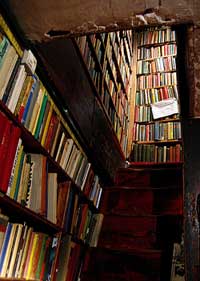
Inviting books
Photo by Chelsea Girl
Christian Classics Ethereal Library continues to improve its website beyond just simply providing free classic Christian literature. However, they need our help to make it work!
In a similar vein to Wikipedia, you can now correct any errors that you may see in books such as spelling mistakes and typos. This is a great improvement as it will help improve the books already provided by this fantastic website.
Here is the full press release that Christian Classics Ethereal Library provided:
This month we are introducing a new way that volunteers can help get books online. At the bottom of each book page, logged-in users will see a link labeled “Correct an error on this page.” You can click that link and actually edit the page—correct typos or make more substantial edits. Changes go into an approval queue. There is also a link labeled “I have proofed this page.” So now volunteers can proof a page on-line, make any necessary corrections, and mark the page as proofed. It’s an easy—and, hopefully, fruitful—way to help distribute and promote classic Christian literature!
Classic books
Photo by Jurek Durczak
Last week Fred Sanders from the Scriptorium blog list the top twelve theology books from the history of Christianity. Obviously this is a subjective list, but there is no doubting it is a list of twelve awesome books.
When I saw the list I instantly thought a lot would be available free on Christian Classics Ethereal Library, as they were primarily classic literature. Then, just as I was about to write this post Fred sent an update confirming that eleven of the twelve books are available free!. Ten of these are from Christian Classics Ethereal Library, and one (Cyril of Alexandria) from The Tertullian Project. In fact the other one, the first on the list below is books from the bible so I trust you will all be okay getting a copy of that!
I have added these books to my list of ‘must-read’ titles to study. We have such a heritage of superb and deep Christian writing it is crazy not to read them.
Here is the full list of titles:
- The Bible. Selections: Paul’s Letters and the Gospel of John.
- Irenaeus of Lyons, Demonstration of the Apostolic Preaching.
- Athanasius of Alexandria, On the Incarnation.
- Gregory of Nazianzus, The Five Theological Orations.
- Cyril of Alexandria, On the Unity of Christ.
- Augustine of Hippo, The Enchiridion on Faith, Hope, and Love.
- Anselm of Canterbury, Cur Deus Homo (Why God Became Man).
- Thomas Aquinas, Summa Theologiae selections.
- Martin Luther, Selections.
- John Calvin, The Institutes.
- The Heidelberg Catechism by Ursinus and Olevianus
- John Bunyan, Pilgrim’s Progress.
Is there any books you would add to this list?
This is the first of a three part review of the year for free Christian resources. May and June were undoubtedly exciting months, with the blog launching at the end of May. It was quickly moved from the WordPress.com platform onto a self hosted WordPress set-up. As I settled into blogging, I was able to review some fantastic Christian websites including:
eSword
Without doubt eSword is one of the best free Christian resources you can get on the internet. It is a high quality piece of software (PC only) that really helps studying the bible.
Bible Gateway
Whilst eSword requires a download, Bible Gateway is a good online bible study tool. It is simple to use, and also has lots of extras that allow you to easily link from your website to the verses on their website.
Christ Art
Christ Art is probably the best Christian website with free clip art. There are lots of images and they are generally of a very high quality. They had one particularly good Christmas clip-art that I have recently shown on the ‘Where to find the best free Christmas clip art’ post.
Christian Classics Ethereal Library
Christian Classics Ethereal Library has more classic Christian books available online than you can shake a stick at. With so many books have been written over the last two thousand years this is a real treasure trove of rich, uplifting and challenging books.
“I am a very little soul, who can offer only very little things to the Lord.”
The Autobiography of St. Therese of Lisieux (Story of a Soul or l’Histoire d’une Ame)has recently been added to the The Christian Classics Ethereal Library.
Here is a brief excerpt of the book:
Just as a torrent carries into the depths of the sea all that it meets on its way, so, my Jesus, does the soul who plunges into the shoreless ocean of Thy Love bring with it all its treasures. My treasures are the souls it has pleased thee to unite with mine; Thou hast confided them to me, and therefore I do not fear to use Thy own words, uttered by Thee on the last night that saw Thee still a traveller on this earth. Jesus, my Beloved! I know not when my exile will have an end. Many a night I may yet sing Thy Mercies here below, but for me also will come the last night, and then I shall be able to say: “I have glorified Thee upon earth: I have finished the work which Thou gavest me to do. I have manifested Thy name to the men whom Thou hast given me out of the world. …”
St. Therese of Lisieux (1873-1897), from “Chapter 6: A Canticle of Love,” in Story of a Soul: The Autobiography of St. Therese of Lisieux


Paul Baloche
Desperation Band
Brian Doerksen
Don Moen
Desiring God
The Practice of the Presence of God
Tags:
Related posts on this site:
content rss
email newsletter